
Self-Drive Camping Botswana: A Compete Wilderness Guide
A self-drive camping safari in Botswana is one of the ultimate wilderness adventures on earth, offering the raw thrill of navigating deep sand tracks and sleeping in completely unfenced campsites surrounded by wildlife. Because the national parks are highly protected and strictly limit visitor numbers, a successful trip requires extensive, meticulous planning—often up to a year in advance.
Embarking on a self-drive camping safari in Botswana is widely considered the ultimate overlanding expedition in Africa. Botswana deliberately keeps its national parks raw and low-volume: you will navigate deep sand, cross rivers, and camp in completely unfenced campsites where wildlife walks right through your camp at night.
Because of the deep wilderness, extreme remoteness, and lack of park facilities, a self-drive trip here requires strict self-sufficiency, rigorous advanced planning, and a fully equipped 4×4 vehicle.
️ The Ultimate 4×4 Camping Circuits
Most independent travelers land in Maun (the gateway to the Okavango Delta) or Kasane (near Chobe) to pick up their outfitted vehicles. The two classic routes provide vastly different experiences:
The Great Northern Circuit (7 to 14 Days): This is the most iconic route. It typically runs from Maun to Kasane (or vice-versa), cutting directly through the Moremi Game Reserve (Okavango Delta), the community-run Khwai Concession, the treacherous sand trenches of Savuti, and finally Chobe National Park. Expect dense concentrations of elephants, massive lion prides, and river-crossing challenges.
The Desert & Salt Pans Route (5 to 9 Days): For travelers looking for eerie silence and massive star-filled horizons, this route connects the Central Kalahari Game Reserve (CKGR) with the shimmering salt flats of the Makgadikgadi & Nxai Pans. This terrain requires extreme self-sufficiency, as water and facilities are practically non-existent.
Self-Drive Camping Botswana
Mandatory Vehicle & Equipment Setup
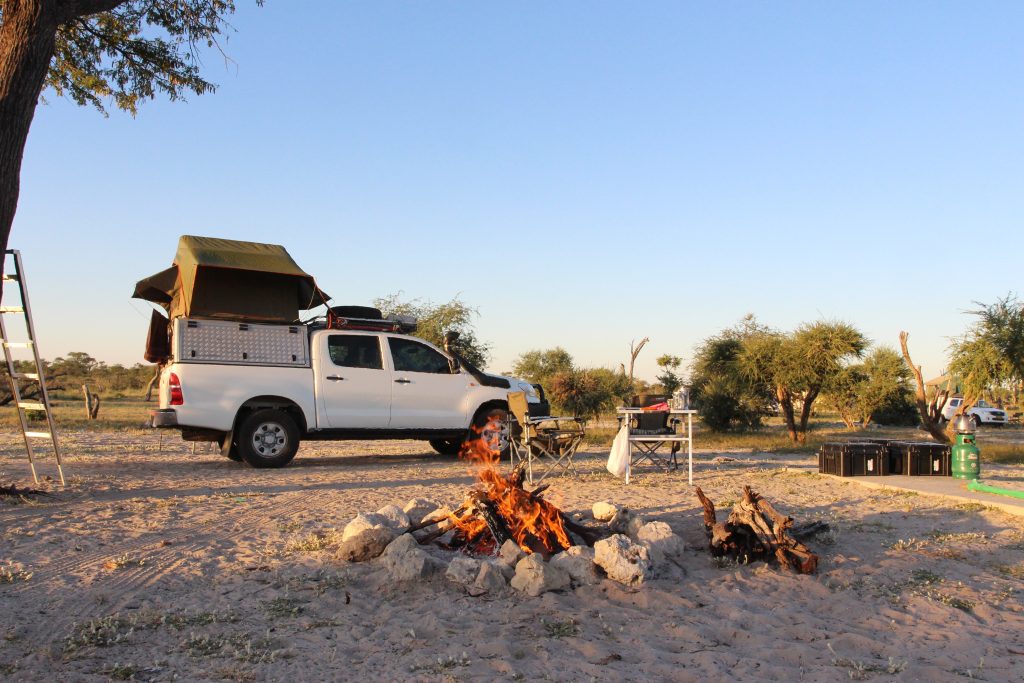
A standard SUV will not survive the interior tracks of Botswana’s national parks; you require a heavy-duty, expedition-ready 4×4 (such as a Toyota Land Cruiser or a Toyota Hilux Double Cab) equipped with:
Rooftop Tents: Wildlife wanders through camps freely. Sleeping elevated on a high-clearance vehicle roof adds a vital layer of safety and peace of mind.
Long-Range Capabilities: Vehicles must feature dual fuel tanks or carry multiple metal jerry cans. There are no fuel stations or shops inside the national parks.
Recovery Gear: You must carry a high-lift jack, heavy-duty sand shovel, a tow rope, and at least two spare tires. Sharp mopane roots and deep sand frequently cause punctures and frame-deep bog-downs.
Offline Navigation: Cell signal vanishes the moment you leave major tar roads. Download reliable offline maps like Maps.me or purchase a dedicated GPS pre-loaded with tracks from the specialized platform Tracks4Africa.
Critical Rules for Unfenced Wilderness Camps
Camping in Botswana’s national parks (managed by the Department of Wildlife and National Parks – DWNP) means sharing your living room with apex predators. Adhere strictly to these protocols:
Sit with your back to your vehicle: When relaxing around the campfire, position your chairs against your 4×4 so nothing can approach you from behind unnoticed.
No food in ground tents: If using any ground tents, keep them completely free of food, trash, or heavily scented toiletries. Store all meat and groceries inside your vehicle’s integrated 12V fridge or secure canopy boxes to prevent attracting hyenas and elephants.
Strict night lockdown: Once the sun sets, stay inside your campfire radius or up in your rooftop tent. Never walk away from the campsite after dark. If you hear animals moving through, stay completely still inside your secure tent.
Zero trace policy: Burn all used toilet paper if wild-camping or using long-drop facilities, and bury all organic waste deeply. Pack out every single scrap of your plastic and aluminum garbage back to major hub towns.
️ When to Go and Booking Logistics
The Dry Season (May to October): This is the optimum time for self-driving. The intense heat backs off, the seasonal water tracks dry up to make driving manageable, and wildlife congregates predictably around major rivers and waterholes.
The Booking Window: Because Botswana intentionally limits campsite numbers to preserve exclusivity, spots in prime sectors like Savuti or Moremi must be booked up to 11–12 months in advance. You cannot simply show up at a park gate without an original campsite voucher issued by the DWNP or private concession operators.